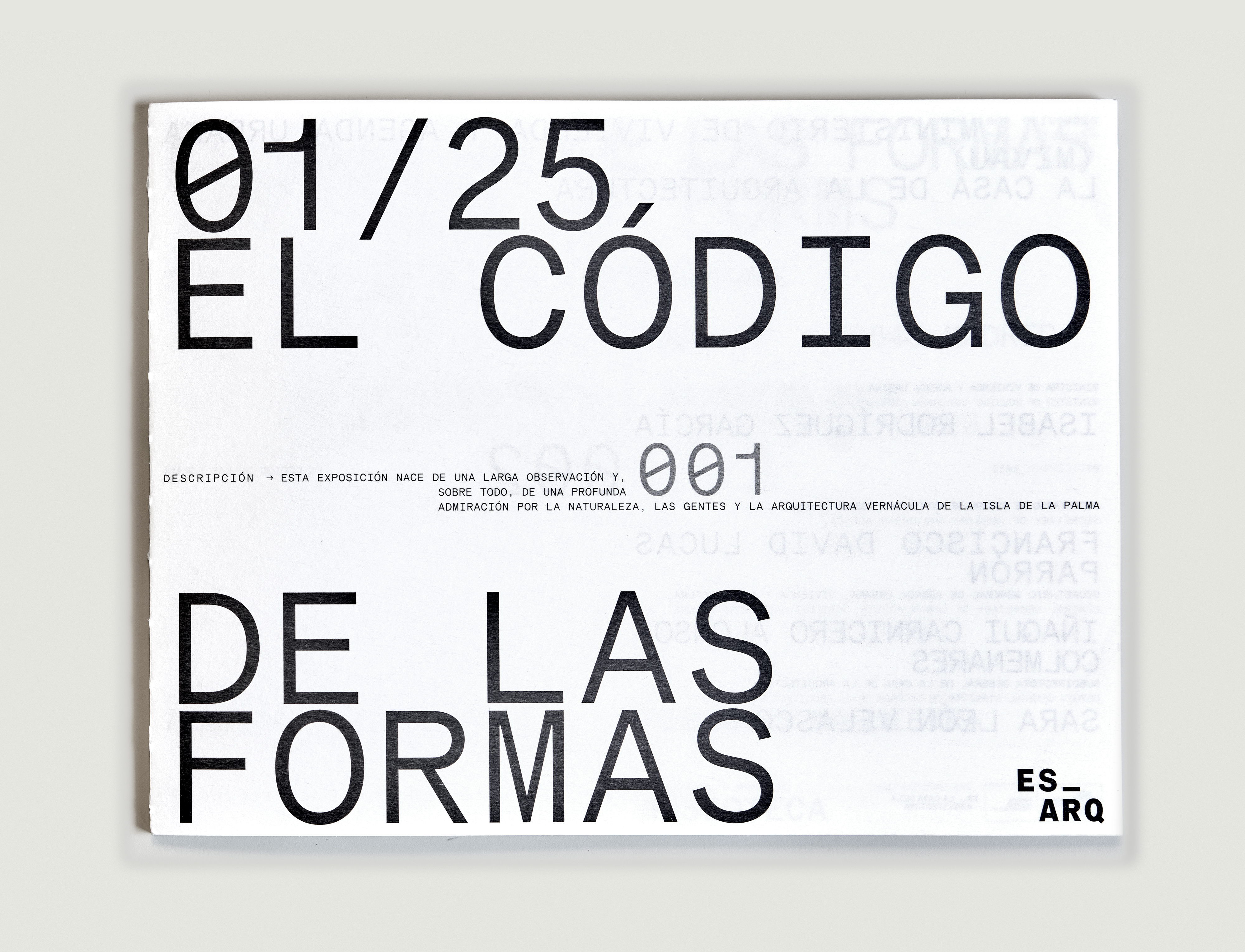
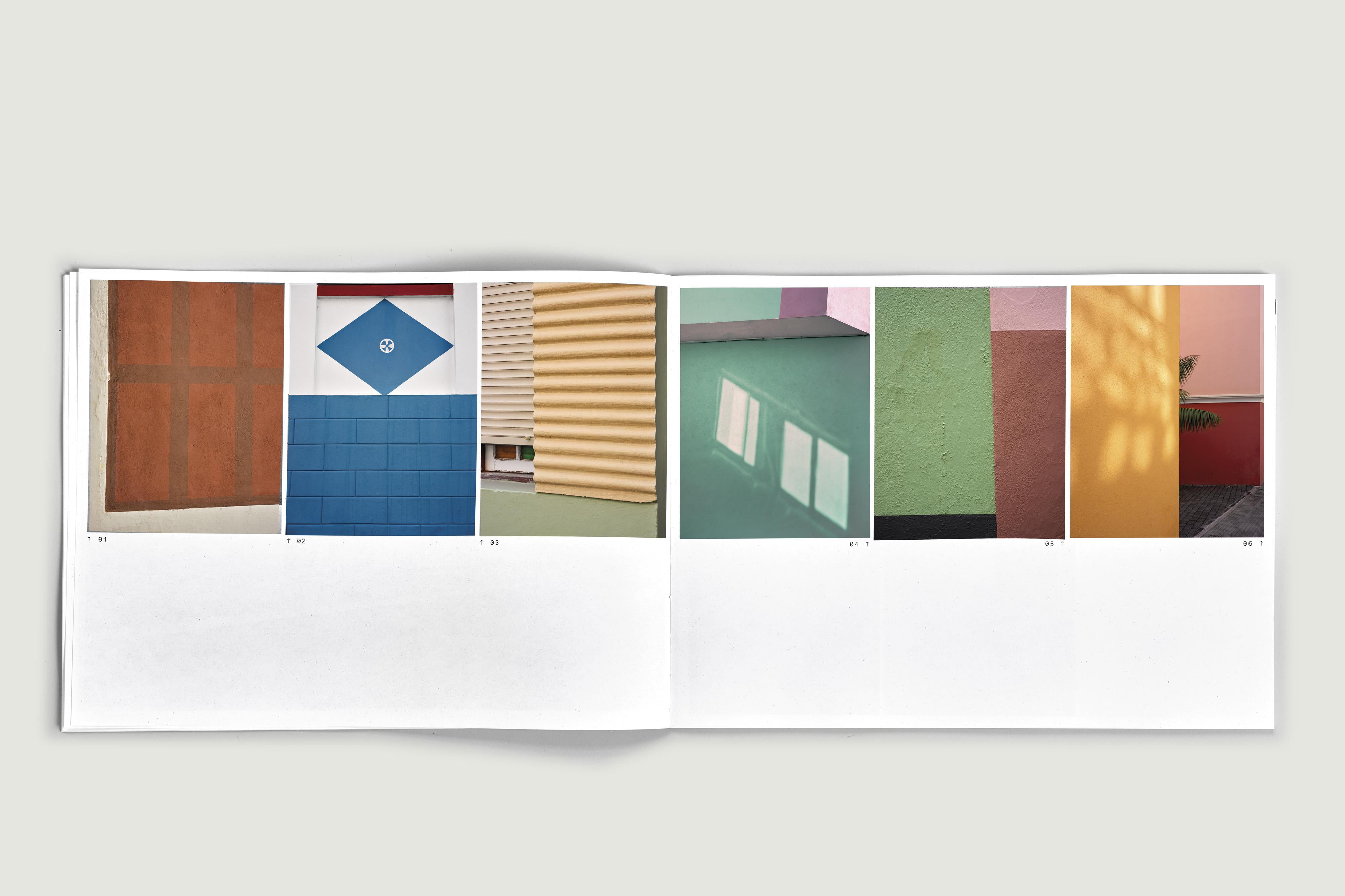
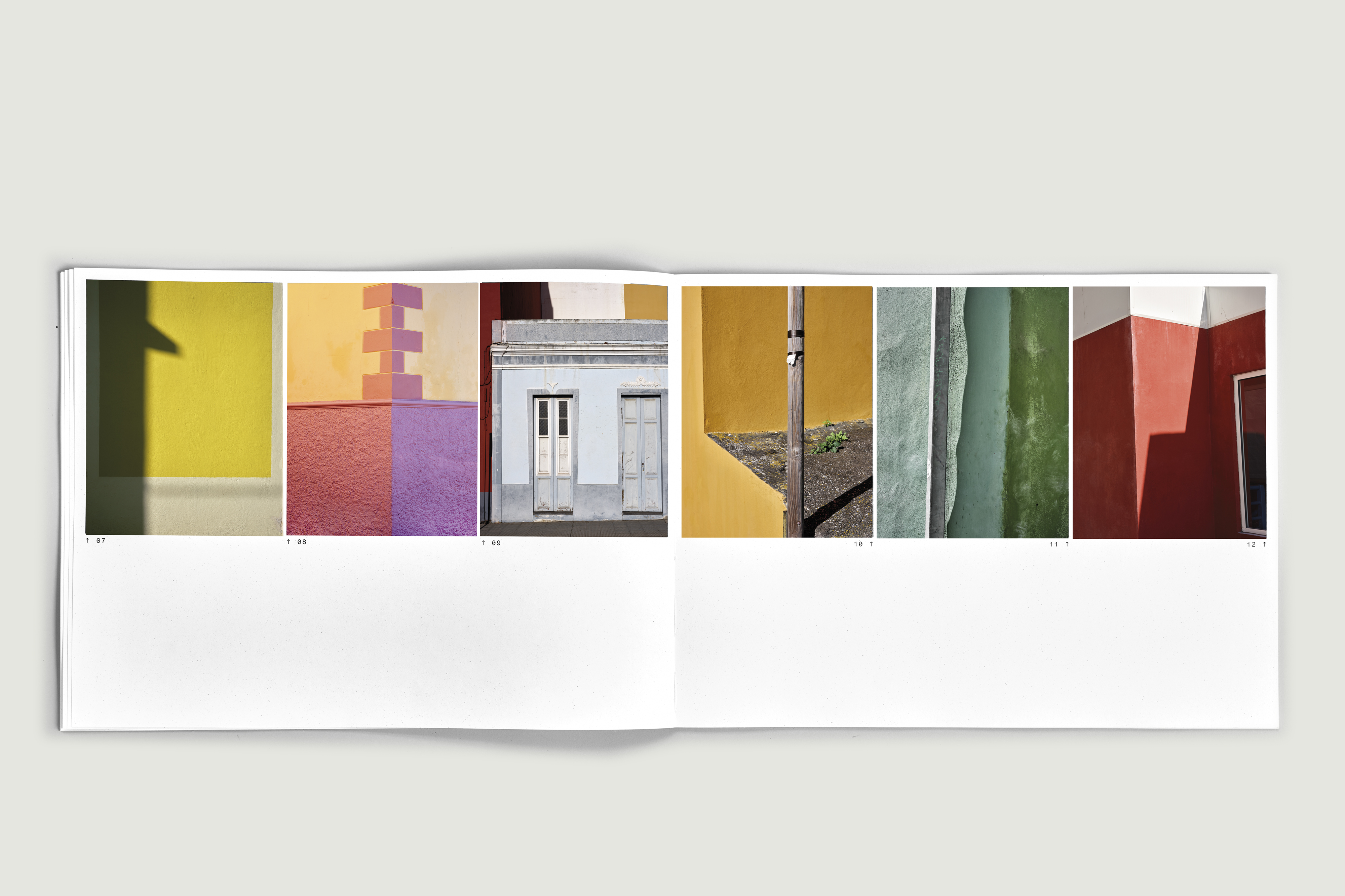
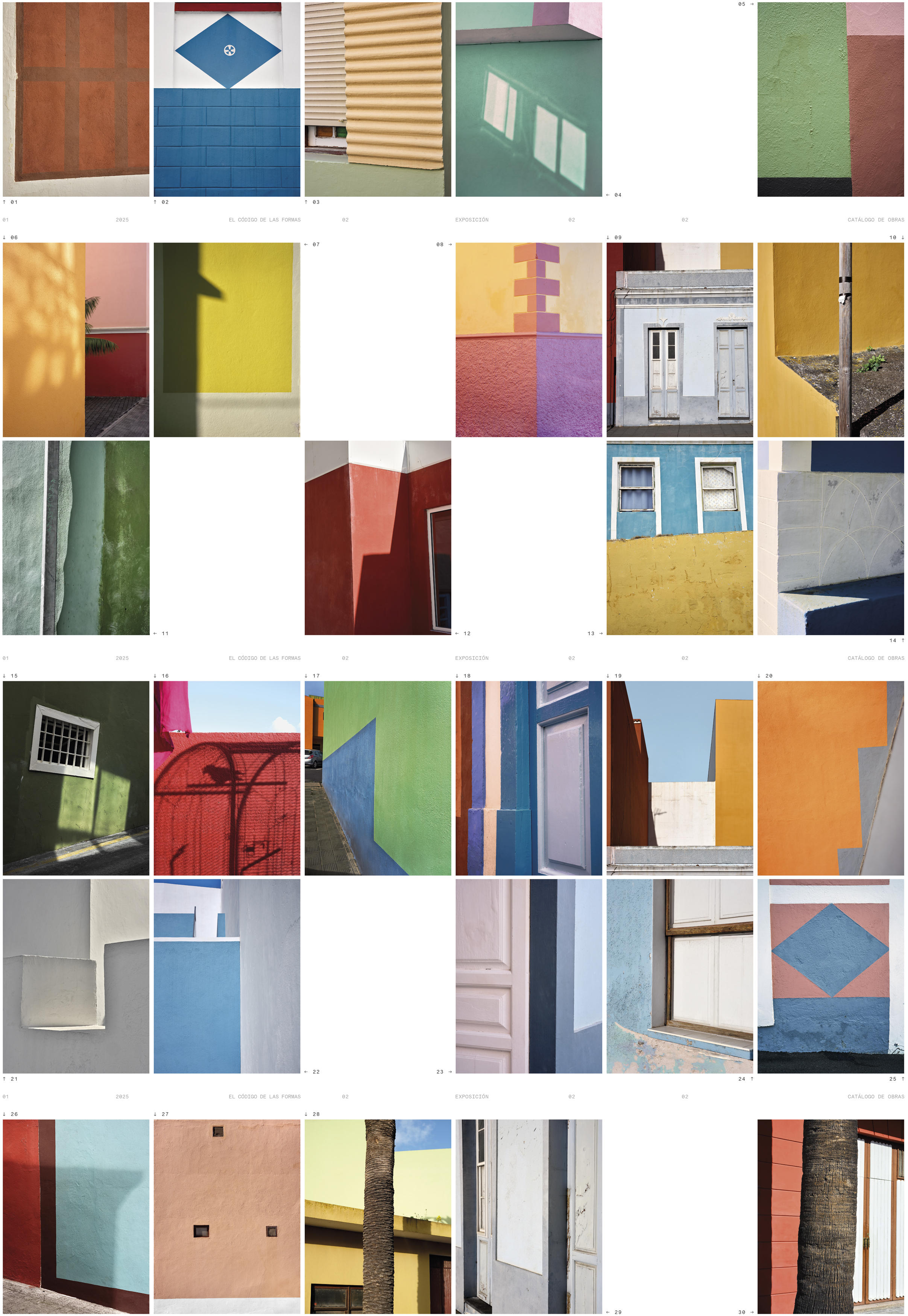
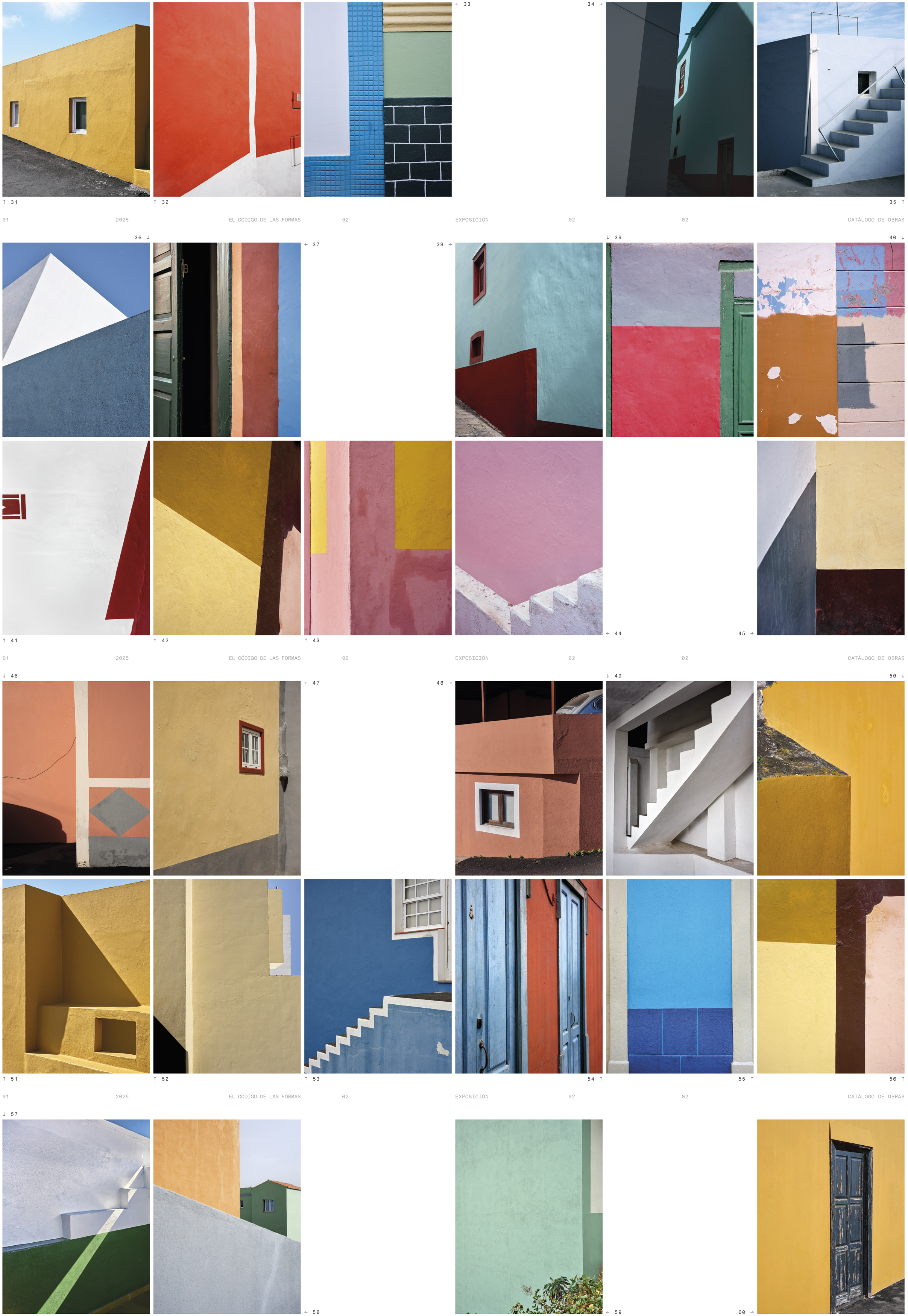
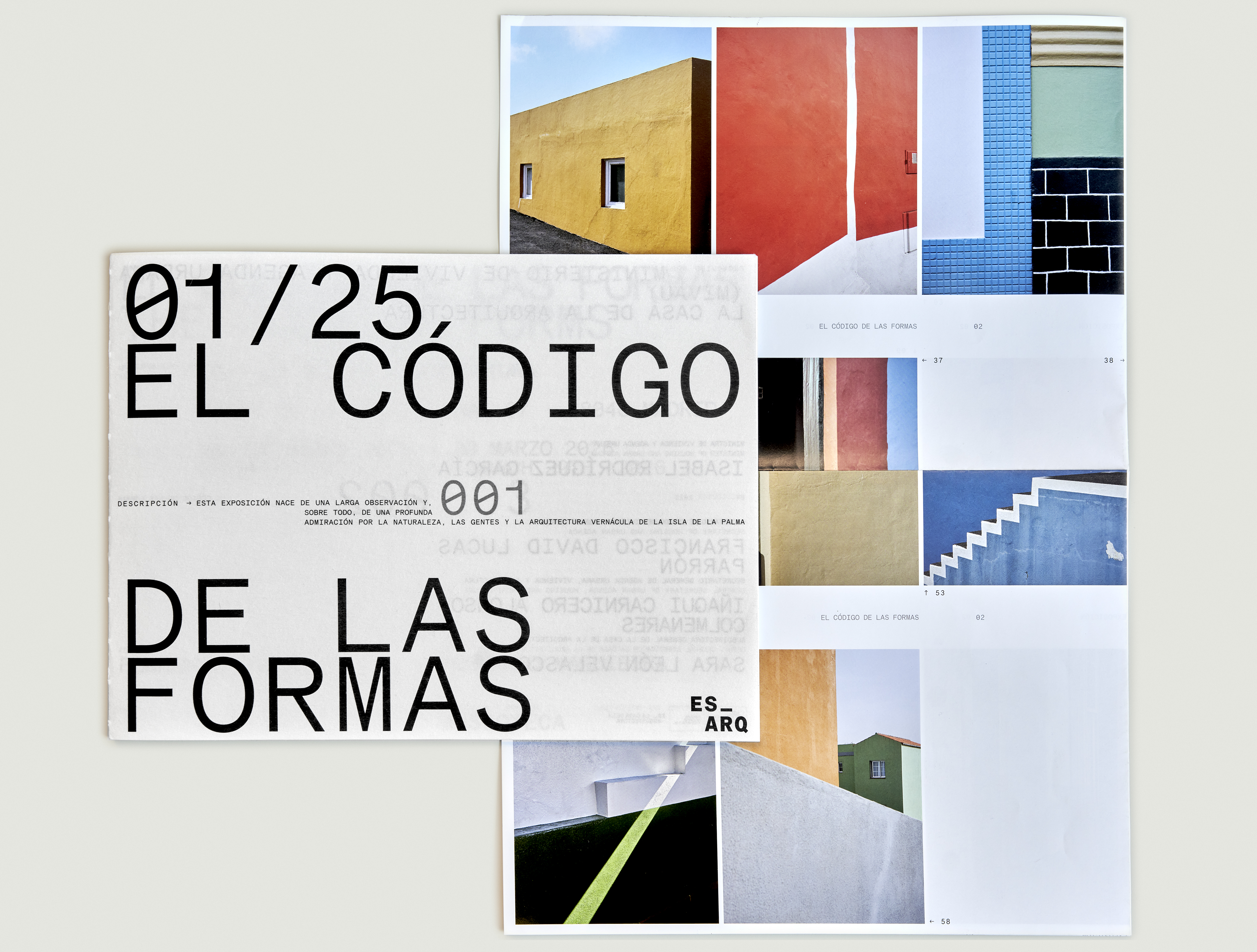
Publication of the exhibition at the Casa de la Arquitectura, from 18 December 2025 to 29 March 2026.
A Conversation with Fernando Maquieira on
El código de las formas
with Carlos Martín, writer and art historian
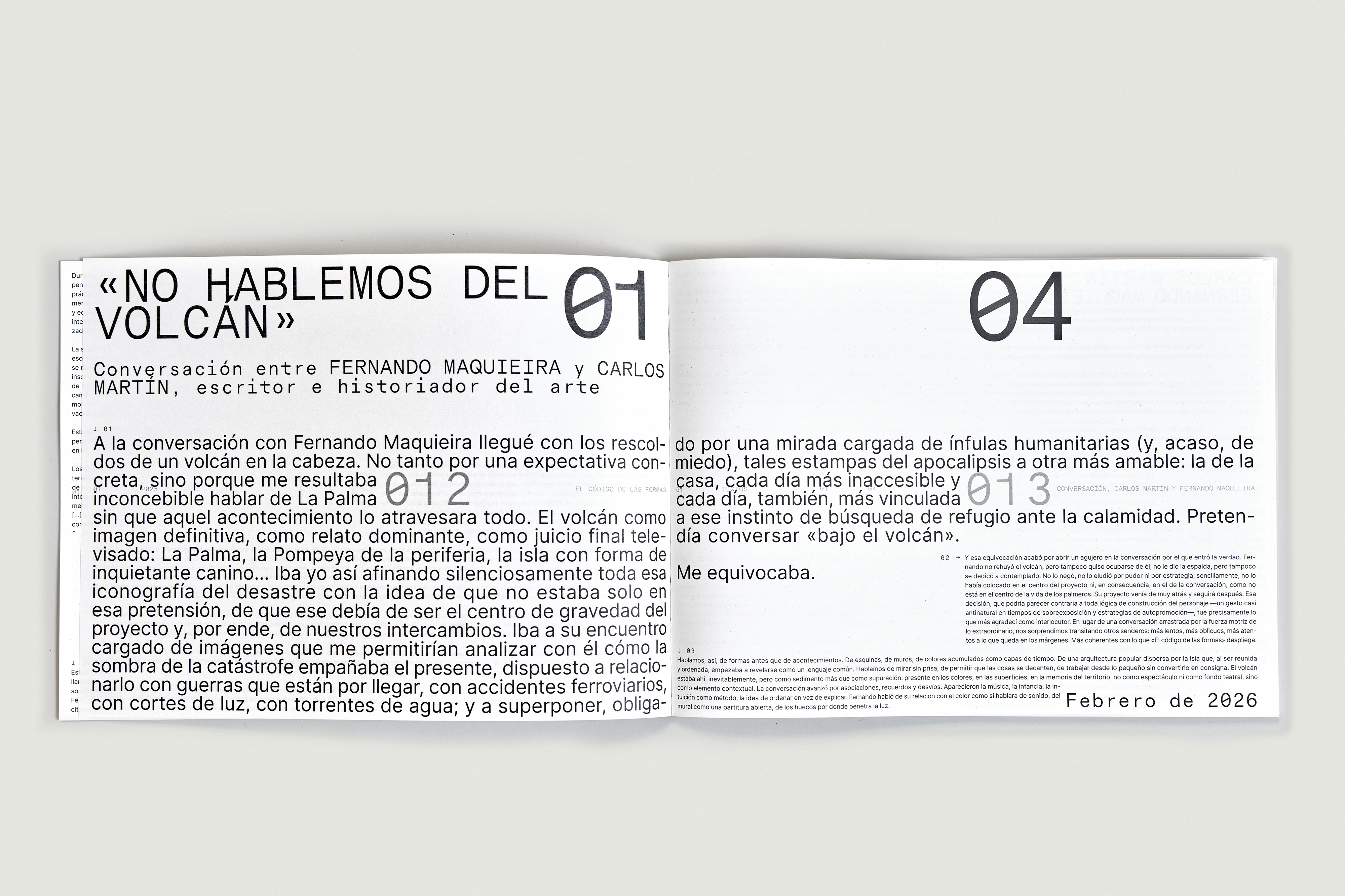
LET’S NOT TALK ABOUT THE VOLCANO
I came to my conversation with Fernando Maquieira with the embers of a volcano still smouldering in my mind. Not so much because I had any specific expectations, but because I found it inconceivable to speak about La Palma without that event permeating everything. The volcano as the definitive image, the dominant narrative, the televised Last Judgement: La Palma, the Pompeii of the periphery, the island shaped like an unsettling canine… I was silently sharpening this entire iconography of disaster, imagining that I could not be alone in this assumption, that this must surely be the project’s centre of gravity and, consequently, that of our exchanges.
I went to meet him carrying a whole array of images that would allow me to explore with him how the shadow of catastrophe had clouded the present, ready to connect it with wars yet to come, railway accidents, power cuts, torrents of water; and, compelled by a gaze imbued with humanitarian pretensions—and perhaps fear as well—to superimpose these visions of apocalypse onto another, more benign one: that of the home, increasingly inaccessible and, at the same time, increasingly bound up with that instinct to seek shelter in the face of calamity.
I intended to conduct our conversation beneath the volcano.
I was wrong.
And that mistake eventually opened a hole in the conversation through which the truth entered. Fernando did not shy away from the volcano, but neither did he wish to concern himself with it; he did not turn his back on it, but nor did he devote himself to contemplating it. He did not deny it, nor avoid it out of modesty or strategy; he simply had not placed it at the centre of the project and, consequently, not at the centre of our conversation either—just as it is not at the centre of the lives of the people of La Palma. His project had begun long before, and it would continue afterwards.
That decision, which might seem to run counter to every logic of constructing an artistic persona—an almost unnatural gesture in an age of overexposure and strategies of self-promotion—was precisely what I most appreciated as his interlocutor. Instead of a conversation driven by the propulsive force of the extraordinary, we found ourselves following other paths: slower, more oblique, more attentive to what remains at the margins. Paths more consistent with what El código de las formas unfolds before us.
And so we spoke of forms rather than events. Of corners, walls, colours accumulated like layers of time. Of a vernacular architecture scattered across the island which, once brought together and ordered, began to reveal itself as a common language. We spoke about looking without haste, about allowing things to settle, about working from the small without turning it into a manifesto.
The volcano was there, inevitably, but as sediment rather than suppuration: present in the colours, the surfaces, the memory of the territory; not as spectacle or theatrical backdrop, but as an element of context. The conversation unfolded through associations, memories and digressions. Music emerged, as did childhood, intuition as a method, the idea of ordering rather than explaining. Fernando spoke about his relationship with colour as though speaking about sound, about the mural as an open score, about the openings through which light enters.
February 2026
Carlos Martín: I would like to begin with the genesis of the project, even before the volcano. How did what would later become El código de las formas originate?
Fernando Maquieira: I first came to La Palma in 2016, although my relationship with the Canary Islands went back further. I didn’t arrive with a defined project or a preconceived idea. I began travelling around the island in a very intuitive way, photographing almost as a means of orienting myself, of experiencing a journey, of filtering things through myself. The island really struck me because it reminded me of all those landscapes and mental images that come from the literature of islands.
For me, photography is not so much a means of documenting as a tool for getting to know places. I walk, I look, I look again, and little by little things begin to connect in my mind. Some ideas are discarded and others remain, but it is always a slow process, one of accumulation rather than prior decision.
CM: In that first encounter with the island, something appears very early on in your photographs: the shape of the territory. That angular, vertical, almost aggressive quality of the landscape. When did you begin to realise that there was something there beyond a backdrop or, let’s say, an image that could be romanticised?
FM: Very early on. La Palma is a very particular island in that respect: it is extremely vertical, very abrupt, sharp, angular, as you say. Its terrain is not gentle. As I travelled around it, I realised that those angles were not only present in the landscape but also in the architecture. The houses, terraces, walls, corners… everything seemed to respond to the same geometric logic, to that fascination with edges that I kept encountering at every turn.
That is where the idea of La isla de la esquina began to emerge. It is a broader project that predates the volcano, in which I was interested in thinking about the island as a boundary, as a periphery, as a place situated in a corner of the map, but also as a space charged with symbolism.
CM: The idea of La isla de la esquina clearly predates the volcano, but inevitably everything one looks at in La Palma today passes through that event. How have you incorporated the volcano into the work?
FM: I realised fairly quickly that the volcano was not going to occupy the centre of the work. When the eruption happened, I was there. I took many photographs and followed the process very closely with people from the UME [Military Emergency Unit], but I soon felt that this was not my place. Not because it didn’t affect me—it affected me enormously—but because I couldn’t find my own voice in the spectacle of the volcano, in the poetics of disaster or of the sublime.
It was an event being broadcast live to the entire world, with thousands of images produced every day. I had nothing new to contribute from that perspective. Besides, the project I was developing already existed before the eruption, and changing it in order to jump onto that subject would have felt dishonest, both towards myself and towards the work itself. Not to mention opportunistic.
CM: And yet the volcano is there, even if not explicitly. Looking at the images, one cannot help thinking about it, about what happened, about the houses that are no longer there. How do you manage that unavoidable presence without turning it into the subject?
FM: By accepting that it is going to be there, but allowing it to remain in the background. The volcano appears implicitly, in the colours, in the black surfaces, in certain sediments that can be sensed. I wasn’t interested in photographing the volcano as spectacle, as an icon of catastrophe or as a metaphor for anything.
Another reason for not doing so is that the people of La Palma are tired of being identified solely with that event. I have a very close relationship with the island and its people, and it seemed important to respect that sensitivity, that truth. The volcano is part of the context, of course, but my interest lay elsewhere: in forms, in everyday architecture, in what remains beyond a particular event.
CM: All right… let’s not talk about the volcano. Let’s turn to another subject that is essential when we consider the context in which you are presenting the work: you work with a popular architecture that is almost invisible, despite the renewed and growing interest in what is generally called the vernacular. When did you decide that this would become the centre of the project?
FM: It was something that gradually settled over time, when I began printing the photographs and looking at them from a distance—with precisely the distance between centre and periphery. And here the periphery is my studio; the centre is the work.
I often work this way: I photograph very instinctively and then, months later, back in the studio, I begin to understand what I had been looking at without fully knowing it at the time. That is when I realised that the architecture and the angular landscape of La Palma were completely interconnected. The single-storey houses, party walls, traditional La Palma roofs, the sharply defined corners… None of that was merely functional; it also carried an enormous formal charge. And I began to see that through those forms and colours it was possible to tell the story of the island in a very different way, without resorting to grandiloquence.
CM: When all those façades, walls and corners are brought together, it feels as though you are constructing something that does not actually exist on the island as such: a kind of imaginary city made from scattered fragments.
FM: Yes, absolutely. On the island those houses are scattered, isolated from one another, except in certain specific settlements. They don’t form a visible ensemble. When they are brought together in the mural, what appears is a kind of accumulated architecture, as though all those pieces formed part of a single organism.
It is a fictional construction, but one made from real elements. In that sense, it almost seems like the work of a single author, when in fact it is a collective, anonymous authorship, the result of many individual decisions repeated over time. That was what interested me: making visible something that was already there but that can only be perceived when it is ordered and placed in relation to other things.
CM: In that respect, there is something I find very powerful: the idea of an architecture without architects, or of a collective author. Looking at the mural, one might imagine that it responds to a single system, a single hand.
FM: For me, the authorship is entirely collective. There is no master plan and, in most cases, no conscious artistic intention, but rather forms and tones that are inherited, passed on, that relate to one another almost by osmosis. They are practical decisions, shared tastes, almost unconscious repetitions. Someone paints their house in a certain way because they have seen another one like it, because they like that colour, because that is how it has always been done.
Over time, this generates a common language, a kind of visual identity. And what is interesting is that this language ends up having an extraordinary coherence. I don’t invent anything; I simply point it out. Photography, in this case, acts as a tool for revealing a collective logic that normally goes unnoticed.
CM: There is one element running throughout the project that you yourself emphasise in the exhibition text: colour understood almost as sediment, as a layer of time. What role does that idea play in El código de las formas?
FM: Colour is fundamental. Each layer of paint is literally the trace of a life, of a moment, of a domestic decision. I like to think of those layers as sediments, as in geology. A house is painted, repainted, changes colour, and through that process it accumulates history.
In La Palma this is very evident, and it also inevitably connects with the idea of the volcano, even if it is never named. The colours are not merely decorative; they are memory. And when you bring them together, when you place them side by side, a kind of visual stratigraphy appears, speaking about the passage of time and about how a place is inhabited.
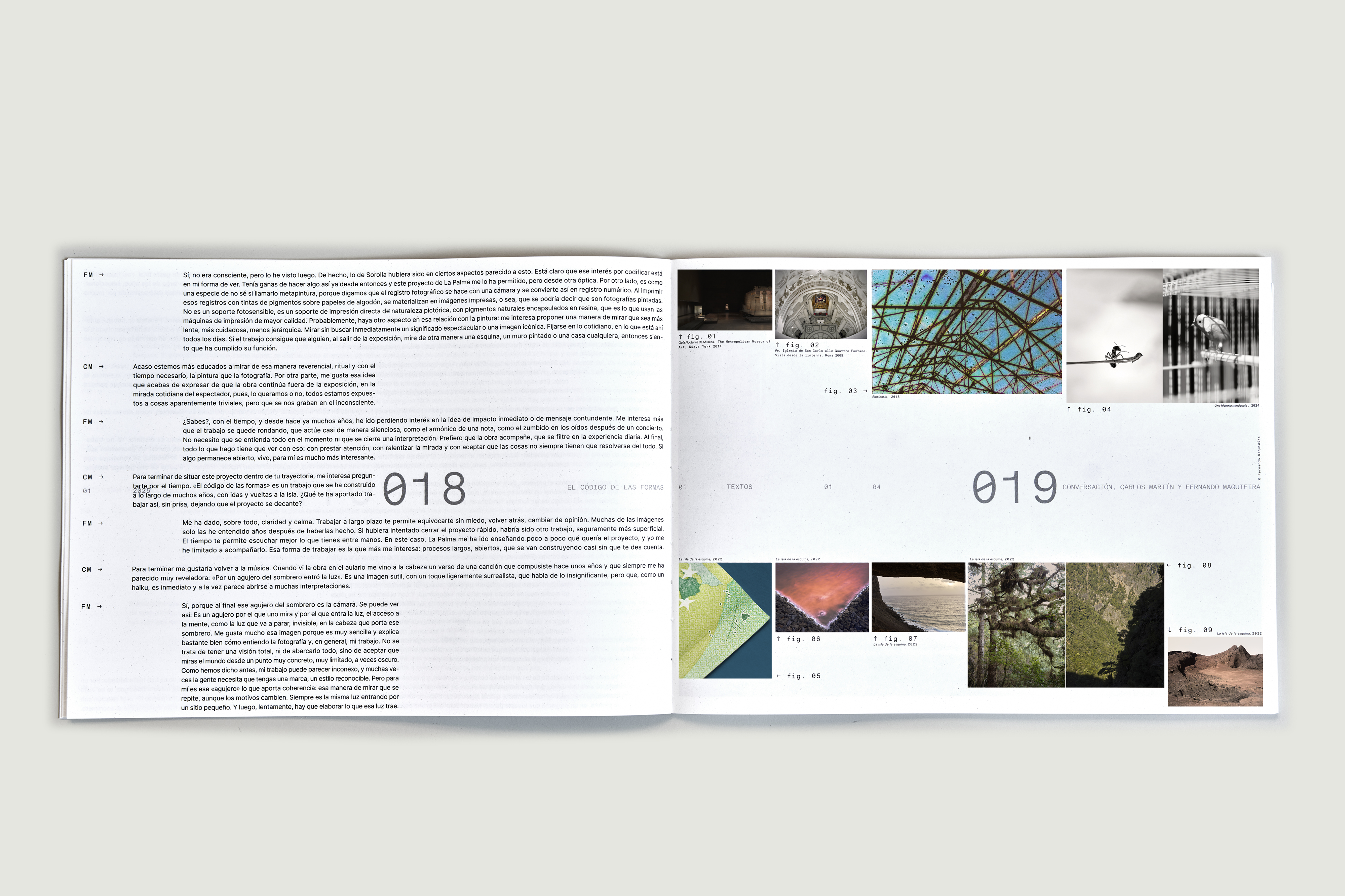
CM: So we are talking about the volcano after all… You know, precisely that attention to the small, the apparently secondary, I would even say the insignificant, connects very strongly with other works of yours. I’m thinking of the ants at the heart of Una historia minúscula, the fungi that appear in Alucinosis, even the bonsai trees you photographed in a completely audacious way for the commission that became A los pinos el viento. Would you say there is a clear continuity between those projects and El código de las formas?
FM: Yes, absolutely. I have always been interested in things that, at first sight, seem insignificant. Not because they are insignificant, but because we tend to pass over them without really looking. There are so many layers of information in small things, so much emotion and so much resilience.
In La Palma this is very clear: it is a difficult territory, worked over generations with an extraordinary degree of vernacular knowledge. That humble architecture speaks of survival, adaptation and intuition. And that is something that runs through almost everything I do, even though the subjects or forms may change.
CM: I find that your work in general is strongly imbued with a sense of tenderness, with an almost childlike gaze. You also frequently position the camera quite low, as though trying to adopt or emulate a child’s point of view, as you did, for example, in Guía nocturna de museos.
FM: That is very important to me. I try to keep that capacity for wonder alive, that primary curiosity. When you are a child, anything can become an event: a crack, a seed, a patch of colour. As we grow older, we stop looking that way; everything becomes functional or utilitarian.
I try to recover that innocent gaze—not in a naïve sense or anything like that, but as a form of complete attention. I often position the camera lower precisely to force that point of view, so as not to look from a dominant position, to allow myself to be surprised. I think it is that way of looking that enables me to connect with small things and give them value without needing to underline them explicitly.
CM: Since we have mentioned several milestones in your career, I would like to point out that, in a long and highly diverse trajectory such as yours, your projects can sometimes seem to move in very different directions. And yet, when one looks closely—and listens to you—a clear coherence, a voice, reveals itself.
FM: I think the coherence lies not in form but in attitude. I have never been interested in constructing a style or creating a formally recognisable brand. The only constant in my work is intuition and a particular way of looking.
Each project asks for a different form: sometimes colour, sometimes black and white, sometimes text, sometimes installation. On the surface that may give an impression of dispersion, but over time you realise that there is a very clear thread running through it all, that there is a voice behind it, even though it may have different textures, different registers. It takes many years to see that, even to accept it. I myself only began to recognise it relatively recently.
CM: Your mention of vocal registers gives me an opening to talk about music. When I had to write a short biography of you more than a decade ago, before we had met in person, I interviewed you by phone. I remember that you immediately spoke about your relationship with music. Since then, moreover, I have had the good fortune to play music with you.
I have always perceived you as a musician, a composer, and also as a musical director, an orchestrator: someone capable of bringing an entire band together and playing simultaneously, with a finely tuned ear for sensations, for distilling the mass of sound created by several performers. I think that highly refined perception you have of layers of sound reverberates in El código de las formas.
Musical chromaticism, as you know, is defined as the use of altered notes that do not belong to the principal diatonic scale and that add “colour” and emotion to a melody. I think that is what happens here. And this code is your set of notes: an attempt to discern, to deduce a certain grammar within what initially appears spontaneous, and then to recompose it. Looking at this work, I thought of precisely that: a kind of visual composition made from rhythm, repetition and chromaticism, almost like a musical score.
FM: That’s exactly it, without a doubt. Music has been and continues to be fundamental to the way I understand any creative process. For me, colour functions like sound. There are notes that repeat, variations, silences, counterpoints.
The mural is like an open book or a visual score: there is no single reading and no obligatory route through it. It has immediacy and force, but also details and modulations, some more obvious, others subtler. As in music, there are more euphoric moments and calmer ones, visual refrains, rhymes between images.
I work with the material I have—the photographs—and organise them in search of that rhythm, that overall sensation, rather than a linear narrative. Ultimately, what interests me is that the whole should function as an experience, not as the sum of isolated parts.
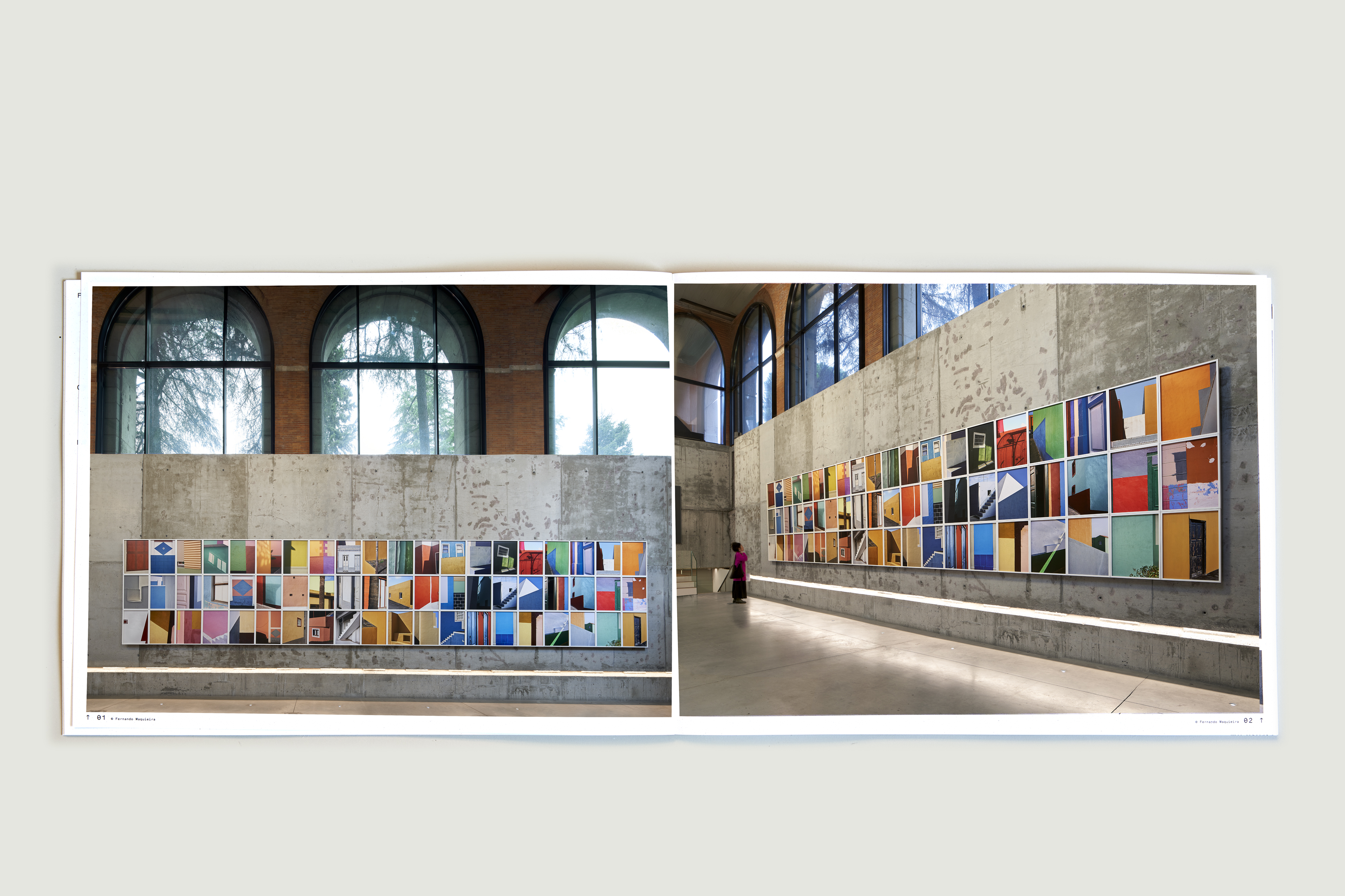
CM: That quality of an open score becomes even more pronounced when the work becomes an installation. I would like us to talk about the installation at the Casa de la Arquitectura, because that is where the project acquires its scale and meaning. It is perceived as a large mural superimposed on the raw concrete of the Aulario.
It creates the effect of an explosion of colour, but an ordered explosion which, at first, does not allow you to see each individual photograph because of the emphatic scenic presence of the piece as a whole. Were you looking for that overall impression, that wall or curtain that suddenly confronts you, that comes towards you almost like an eruption of colour? How did you approach such a specific space, with that raw, dominant concrete wall?
FM: From the outset, I knew the piece had to enter into a direct dialogue with that wall rather than compete with it through some false neutrality; creating a white cube there would have been a mistake. I didn’t want neutral panels or a second architecture that would domesticate the space.
I wanted the mural to function as a second skin, as a symbolic cladding that did not deny its support. The concrete, with its stains, its roughness and its institutional weight, was already there and had to be acknowledged. Against that, colour acts almost as a gesture of affirmation: it does not hide or camouflage itself, but stands in front of it with all its fragility and strength at once.
I could simply have put a white background in the space, which would actually have been technically easier. The fact that we were not allowed to paint the wall was already an interesting constraint, but the biggest one was that we couldn’t drive anything into it.
The mounting system is the result of extremely thorough technical work by our colleagues at Museoteca, a solution that uses the existing holes in the concrete to install bars from which all the photographs are hung on an invisible structure. The result was wonderful; it was perfect, very finely resolved and highly respectful both of the space and of the integrity of the building.
The technical design is formidable because we managed to solve something that was extremely difficult to realise. In fact, the system is going to remain permanently at the Casa for future use.
CM: Seeing it installed, I had the feeling that you were bringing the absolute periphery into the centre, into a space charged with what we might call a “high degree of institutionalism”, saturated with symbolism and political power, and with enormous historical weight as well. The collision between the concrete of the building and the explosion of colour in the mural is very physical.
Were you also seeking that almost political reading, that image of the vandal who assaults a wall by making it beautiful?
FM: Yes, although not in an explicit or programmatic sense. I’m very interested in that idea of occupying space through the popular, through what normally has neither voice nor presence in places like this.
Vernacular, humble architecture enters an institutional building and does not ask permission. It places itself there and asserts its existence. There is something almost Expressionist in that gesture, a celebration of colour and form that refuses to be intimidated by its context.
For me, the strength lies in the accumulation of many small things: together they generate a presence capable of holding its own against any space, however imposing it may be.
CM: Beyond the visual impact, there is something I find very important in this installation: all the work that remains unseen, the prolonged process that precedes it. Journeys, repetitions, editing, printing… You are a photographer, but also a meticulous photographic technician. And that entire process becomes condensed into one very forceful gesture.
Looking at it, I thought of those painters who fill notebooks for years before eventually materialising everything in an apparently minimal gesture.
FM: There is an enormous amount of work behind it, of course, but I’m not interested in that work being literally visible. I like the piece to have something of a final, almost physical gesture, as though the entire process flowed into one clear decision.
Travelling, returning to the same places, photographing a house several times over the years, selecting, discarding, printing… All of that gradually refines the gaze. In the end, when you place the pieces together, it appears immediate, but in reality it is sustained by a great deal of time and many doubts. That final condensation is what gives the whole its strength.
CM: There is something that runs not only through this project but through much of your career: an attention to surfaces—walls, skins, clothing, layers, strata. I was thinking of earlier works such as Fe, also titled Wearing Faith, where you focused on the staging of belief and explained: “Religious and political conviction has developed throughout history in every culture and manifests itself in specific ways through architecture, clothing and art.”
Now you are looking at other surfaces, at this way of “dressing” streets and houses. Here, in a sense, you return to the surface, but through architecture.
FM: I am very interested in the surface as the place where things manifest themselves. In the series Fe, I looked at how religious or political conviction is expressed through clothing, architecture and ornament.
Something similar happens here: the house has already been built, the structure already exists, but then comes the cladding, the paint, the colour. That layer is not secondary; it is where meaning becomes concentrated. Cladding is a way of dressing architecture, of giving it a visible identity. And that identity, although it may appear banal or decorative, says an enormous amount about how a place is inhabited.
CM: Within that interest in the surface there is also something related to the tradition of colour photography in Spain. Looking at the work, I thought of certain references, such as some aspects of Campano or Pérez Siquier’s La Chanca in colour—the prints for whose exhibition at Fundación Mapfre you yourself were responsible.
FM: Both are unavoidable references when you work with colour, surface and vernacular architecture. But the approach here is different. I am not working with a neighbourhood or a clearly delimited place, as was the case with La Chanca, but with something scattered across the entire island.
The houses, walls and geometries appear isolated, dotted throughout the territory. The work consists precisely in finding them, recognising them and then bringing them together. In doing so, something is constructed that does not physically exist, but which reveals a common identity. It is a very photographic operation: isolate, repeat, order and, from there, generate meaning.
CM: As the project progresses, one gets the impression that you are more interested in ordering than in explaining. Not in imposing a closed discourse, but in proposing a way of looking. Would you say that El código de las formas operates in that register?
FM: Without a doubt. In fact, there is a childhood memory that always comes back to me when I try to explain how I work. I don’t know if it sounds rather silly; I’ve never told anyone about it, but it has always stayed very clearly in my mind.
I was six or seven years old. Someone had given me some of those little coloured aniseed sweets, and I realised that I could place the sweets one by one inside the little squares of a racket and they wouldn’t fall through. I started arranging them there by colour. I wasn’t playing any particular game and there was no final objective. It was simply a matter of placing them, repeating a gesture, looking for an order. I remember my mother being delighted by that spontaneous gesture.
Over time, I’ve realised that I am still doing something very similar. In El código de las formas, I am not trying to explain La Palma or its architecture, nor to construct a closed narrative. What I do is bring together things that already exist and arrange them in a particular way.
Once you order them, relationships, rhythms and echoes begin to emerge between them. Meaning is not imposed; it arises from that organisation. Hence the title: it is not a code that has to be deciphered correctly, but an invitation to look carefully and discover your own connections.
CM: I think an artist’s career is also constructed—and sometimes especially so—through commissioned works and projects that were never realised. On the one hand, you are one of the leading photographers of works of art in Spain, and I have seen you engage in a dialogue with painting in order to photograph it faithfully. I have seen you almost speaking with the person who painted it, perhaps centuries ago, trying to understand where the focal points were, and so on.
On the other hand, thinking about this relationship with painting, I couldn’t help recalling a project you conceived for the Museo Sorolla. It was a kind of inventory of gestures and colours, a formal repertoire rather like this one, in which anonymity also predominated.
FM: Yes, I wasn’t aware of it at the time, but I saw the connection later. In fact, the Sorolla project would have been similar to this in certain respects. It is clear that this interest in codifying is part of the way I see things, and I had wanted to do something along these lines since then. This project in La Palma has allowed me to do it, but from another perspective.
And then, on another level, it is a kind of—I don’t know whether to call it meta-painting—because the photographic record is made with a camera and becomes numerical data. But from that camera I then make pigment-ink prints on cotton papers, so in the end it becomes painting. It is not a photosensitive support; it is a direct printing process using pictorial matter, natural pigments encapsulated in resin, which is what these printing machines use.
There is probably another aspect to that relationship with painting: I am interested in proposing a way of looking that is slower, more careful, less hierarchical. Looking without immediately searching for a spectacular meaning or an iconic image. Paying attention to the everyday, to what is there every day.
If the work succeeds in making someone leave the exhibition and look differently at a corner, a painted wall or an ordinary house, then I feel it has fulfilled its purpose.
CM: Perhaps we are more accustomed to looking at painting in that reverential, ritual way, giving it the necessary time, than we are with photography. On the other hand, I like the idea you have just expressed: that the work continues outside the exhibition, in the spectator’s everyday gaze, because whether we like it or not, we are all exposed to the apparently insignificant, and it becomes imprinted on our unconscious.
FM: You know, over time I have become less interested in the idea of immediate impact or a forceful message. I am more interested in the work lingering in the mind, acting almost silently, like the harmonic of a note, like the ringing in your ears after a concert.
I don’t need everything to be understood immediately, nor for an interpretation to be brought to a close. I prefer the work to accompany you, to filter into everyday experience.
Ultimately, everything I do has to do with that: paying attention, slowing down the gaze and accepting that things do not always have to be completely resolved. If something remains open, alive, then for me it is far more interesting.
CM: To finish situating this project within your career, I would like to ask you about time. El código de las formas is a body of work constructed over many years, through repeated journeys to and from the island. What has working in this way—without haste, allowing the project to settle—given you?
FM: Above all, it has given me clarity and calm. Working over the long term allows you to make mistakes without fear, to go back, to change your mind. I only understood many of the images years after taking them.
If I had tried to finish the project quickly, it would have been a different work, probably a more superficial one. Time allows you to listen more carefully to what you have in your hands.
In this case, La Palma gradually showed me what the project wanted to be, and I simply accompanied it. That is the way of working that interests me most now: long, open-ended processes that gradually construct themselves almost without you noticing.
CM: To finish, I would like to return to music. When I saw the work in the Aulario, a line from a song you wrote a few years ago came to mind, one that I have always found very revealing: “through a hole in the hat, the light came in.” It is a subtle image, with a slightly Surrealist touch, that speaks of something insignificant but which, like a haiku, is immediate and at the same time seems to open itself to many interpretations.
FM: Yes, because ultimately that hole in the hat is the camera. You can see it that way. It is a hole through which you look and through which light enters—an access point to the mind, like the light that ends up, invisibly, inside the head wearing that hat.
I like that image very much because it is extremely simple and explains quite well how I understand photography and, more generally, my work. It isn’t about having a total vision, or encompassing everything, but about accepting that you look at the world from a very specific, very limited, sometimes dark point of view.
As we said earlier, my work can appear disconnected, and people often need you to have a brand, a recognisable style. But for me it is that “hole” that provides the coherence: that way of looking that repeats itself even when the subjects change.
It is always the same light entering through a small opening.
And then, slowly, working out what that light brings with it.
A LOOK AT THE LEGACY OF TRADITION
Text by Fernando Vela Cossío, Professor of Architectural Composition
School of Architecture, Universidad Politécnica de Madrid
Manuel Bartolomé Cossío (1857–1935), one of the central figures of what has come to be known as the “Silver Age” of Spanish culture, wrote an extraordinary text entitled “Elogio del Arte Popular” (“In Praise of Folk Art”) for an exhibition of embroidery and lace held in Madrid in May 1913. In it, he spoke of those anonymous creations “whose traditional forms, varying from region to region, are always firmly rooted in the very fabric of social life, irrespective of class, and there they take hold and are perpetuated. A perpetuity, however, that is not static but evolutionary, although its evolution is as gentle as the slow transformations of nature. For folk art, like language—also an anonymous creation born of the same process—embodies precisely the deepest and most enduring elements, those primordial qualities of the collective soul that for this reason are called natural. From this amorphous substratum of the demos there sometimes emerges the distinguished artist and the aristocratic work; differentiations arise, schools develop, inspiration takes flight, the accents of creative genius appear; and all of this, once born, flows back again into folk art and is absorbed by it, nourishing it, just as Mother Earth lives and feeds upon the very beings she has brought forth. Thus, the higher, purer, more conscious and more universal learned and reflective art becomes, the richer, more intense and more distinctive the art of the people grows, for in its natural development it knows, like a living organism, how to turn all good nourishment into its own flesh and blood and make it truly its own.”¹
This text, a masterful synthesis, both literary and precise, encapsulates two of the most important characteristics of popular culture: its rootedness in the social matrix of which it forms part, and the profoundly vernacular expression of its nature, closely bound to a territory that it, in turn, helps to define.
One of Don Manuel’s most distinguished disciples, the architect Leopoldo Torres Balbás (1888–1960), brought the text back to attention a few years later, in January 1922, when he published it in issue 33 of Arquitectura, the official journal of the Sociedad Central de Arquitectos. Founded in 1918, the journal then had the young architect as its first editorial secretary. Torres Balbás—who had graduated from the Madrid School of Architecture in 1917, had a natural inclination towards the study of the built heritage, and had been an outstanding student of both Don Manuel Gómez Moreno (1870–1970) and Cossío in the Archaeology section of the Centro de Estudios Históricos—played a decisive role in the study of Spain’s vernacular architecture. A review of the journal’s early issues provides ample evidence of the interest this heritage already aroused among Spanish architects at the time.
Torres Balbás himself would make a decisive contribution to the understanding of Spanish vernacular architecture with his study “La vivienda popular en España” (“Vernacular Housing in Spain”),² a synthesis of the research he carried out during the 1920s, for which he was awarded the Ateneo de Madrid’s “Charro Hidalgo” Prize in 1923.
During the 1920s and 1930s, at a crucial moment in the theoretical rethinking of architecture itself, an appeal to the great values of vernacular architecture was virtually inevitable. If there was one quality recognised in this traditional heritage, it was precisely its enduring expression, over centuries, of functional, sustainable and economical ways of building. This architecture was characterised by its adaptation to place through the intelligent use of local materials, techniques and traditional construction systems, crystallised in technical and typological solutions that remained almost unchanged over time.
Architecture, a valuable testimony to this extensive universe of folk art, reveals as one of its principal attributes—perhaps its most pronounced—a deep rootedness in tradition. For this reason, vernacular architecture, that collection of architectural objects lost in “the memory of the margins”, as the architect Antonio Fernández Alba (1927–2024) so eloquently described them, has always proved resistant to change. The vernacular builder adapts only when change becomes unavoidable, when the social, economic and cultural environment in which the architecture is embedded changes as well.
While historical architecture, well represented by so-called “high” or formally designed architecture, has been subject to a general evolutionary sequence corresponding to the major transformations in the economic, technological and cultural foundations of urban societies—particularly since the Industrial Revolution—vernacular architecture, by contrast, remained anchored in the cultural framework of the rural societies that created it.
And this is precisely one of the main reasons why its preservation as a living organism is so difficult: when the broader structure supporting its existence—essentially, traditional ways of life—disappears, these buildings become decontextualised archaeological objects, emptied of their original content. They can no longer be fully understood except by considering architecture as one more instrument of culture.
This “architecture without architects”, to borrow the expression coined by Bernard Rudofsky (1905–1988), is the result of a collective process of creation in which there are no individual acts that allow us to identify each builder. It is a communal art of building that has made use of local materials, transforming them into architectural artefacts in which there is generally little significant influence from external building cultures, particularly those we have chosen—perhaps somewhat simplistically—to call “high architecture”.
The construction systems employed by traditional architecture also give it a strongly local character. Among its most outstanding qualities are the efficient use of building materials and the persistence, over generations, of customary ways of doing things. These practices constitute remarkable lessons in architecture and were of particular interest to the architects of the Modern Movement.
As the architectural historian Paul Oliver (1927–2017) aptly observed: “The intimate relationship between society and shelter […] is no less significant in those aspects that most frequently concern the architect when studying vernacular shelter: the siting of buildings, the resources used to construct them, the technology employed in their making, and their suitability to conditions of climate or use.”³
It has often been pointed out that the accelerating disappearance of the remaining examples of vernacular architecture in Spain, as in so many other developed countries, is a consequence of the declining economic vitality and increasing depopulation of rural communities. These two processes have brought about profound changes in ways of life in the Spanish countryside, particularly across the country’s extensive inland regions.
The continued use of traditional building systems has become extraordinarily difficult, both because of the scarcity of materials that were commonly employed in the past and because ancestral techniques for working with them have been abandoned and forgotten. Furthermore, the emergence of a new form of popular culture no longer rooted in tradition has produced new types of buildings in which it is impossible to recognise the once deeply established adaptation to the natural context.
As a result, one of the most distinctive values of vernacular building has been lost: its identity with the territory, both from a physiographic perspective and, above all, from the perspective of human geography.
References
- Bartolomé Cossío, Manuel (1913): “Elogio del arte popular”, in Bordados populares y encajes: exposición. Madrid: Lizarraga y Sobrinos, 5 pp.
- Torres Balbás, Leopoldo (1933): “La vivienda popular en España”, in Folklore y Costumbres de España, vol. III. Barcelona: Alberto Martín.
- Oliver, Paul (1969): Shelter and Society. London: F. A. Praeger. Spanish edition: Cobijo y sociedad. Madrid: Blume, 1978, p. 31.
- Muñoz Cosme, Alfonso (2014): “La Arquitectura Tradicional. Paisaje cultural, historia social y patrimonio inmaterial”, in Patrimonio Cultural de España, no. 8, p. 11. Madrid: Instituto del Patrimonio Cultural de España (IPCE), Ministerio de Educación, Cultura y Deporte.
- Rapoport, Amos (1969): House Form and Culture. New Jersey: Prentice Hall. Spanish edition: Vivienda y Cultura. Barcelona: Gustavo Gili, 1972.
- Winckelmann, J. J. [1764] (1989): Historia del Arte en la Antigüedad. Madrid: Aguilar, p. 83.
- Victor Hugo (1891): Dieu. Paris: J. Hetzel & Cie / Maison Quantin.
- Manrique, César (1988): Lanzarote, arquitectura inédita. Cabildo Insular de Lanzarote.
Texts: Fernando Maquieira, Iñaqui Carnicero, Fernando Vela Cossío and Carlos Martín
Graphic design: Naranjo-Etxeberria
Editorial coordination: Fundación Arquia. Pablo Hernandez Canuedo, Sonia Peralta Muñoz
Printing and binding: Brizzolis
English translation: Eleanor Staniforth
Proofreading: Diego Galar-Irurre
Published by: Casa de la Arquitectura. Ministry of Housing and Urban Agenda, Technical Secretariat-General, Subdirectorate-General for Publications and Documentation Resources.
46 pages
Includes a fold-out poster, 85 × 59 cm


